




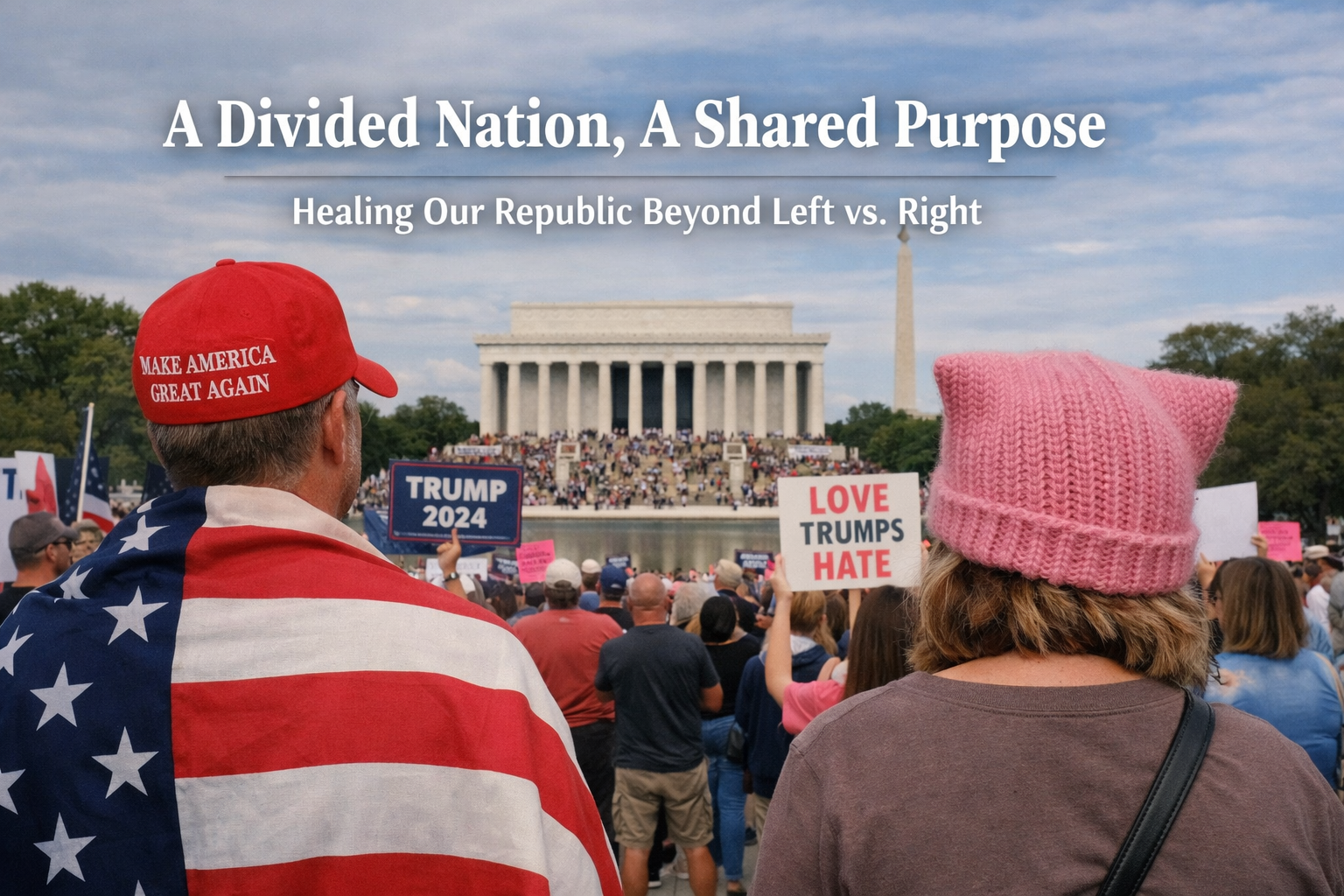
A Divided Nation, A Shared Purpose – Presidents Day in a Fractured Republic
by Wilk WilkinsonOriginally published on Substack. Shared here for broader access.
Presidents Day used to feel simpler.
It was a day for remembering character. Leadership. Sacrifice. Steady hands in turbulent times.
Today, it lands differently.
Because we are not simply divided by policy disagreements or partisan loyalties. We are living in entirely different perceived realities.
Many Americans now inhabit media ecosystems so distinct that we no longer share a common set of facts. Our information diets have become identity markers. The “jersey” someone wears often determines whether we accept or reject what they say before we’ve even heard it.
If “their side” says it, it must be wrong.
If “our side” says it, it must be true.
And into this fracture step the gaslighters, grievance grifters, and outrage entrepreneurs who profit from keeping us inflamed. They monetize suspicion. They reward contempt. They teach us that disagreement equals evil.
But here lies the greater dilemma:
A constitutional republic cannot survive long without a shared commitment to reality, restraint, and respect for institutions.
And few institutions carry more symbolic and constitutional weight than the office of the presidency.
The Office Is Bigger Than the Man
Presidents are human. Fallible. Political. Often deeply flawed.
But the office they hold is not merely personal. It is constitutional. It is symbolic. It represents continuity of the republic itself.
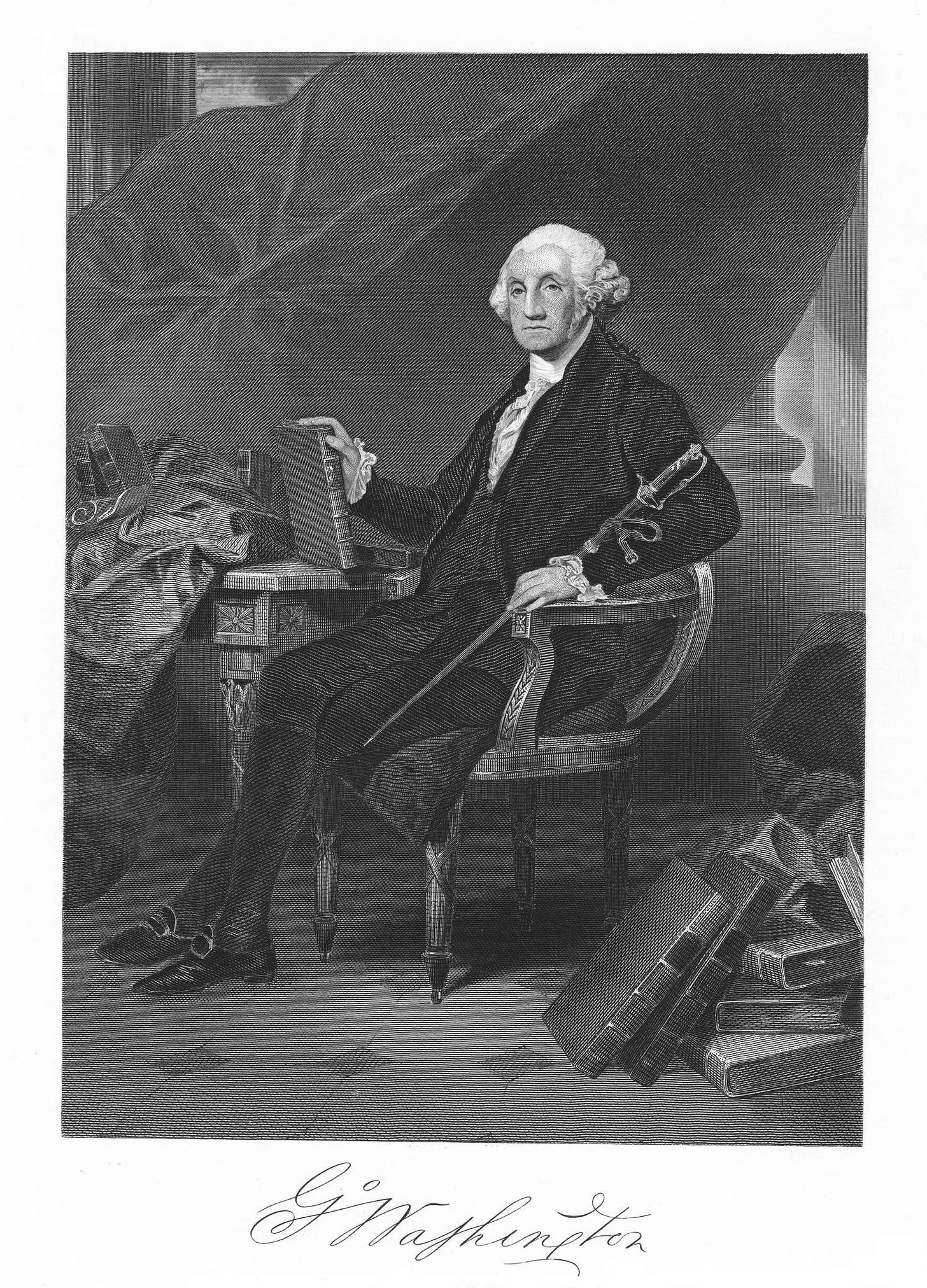
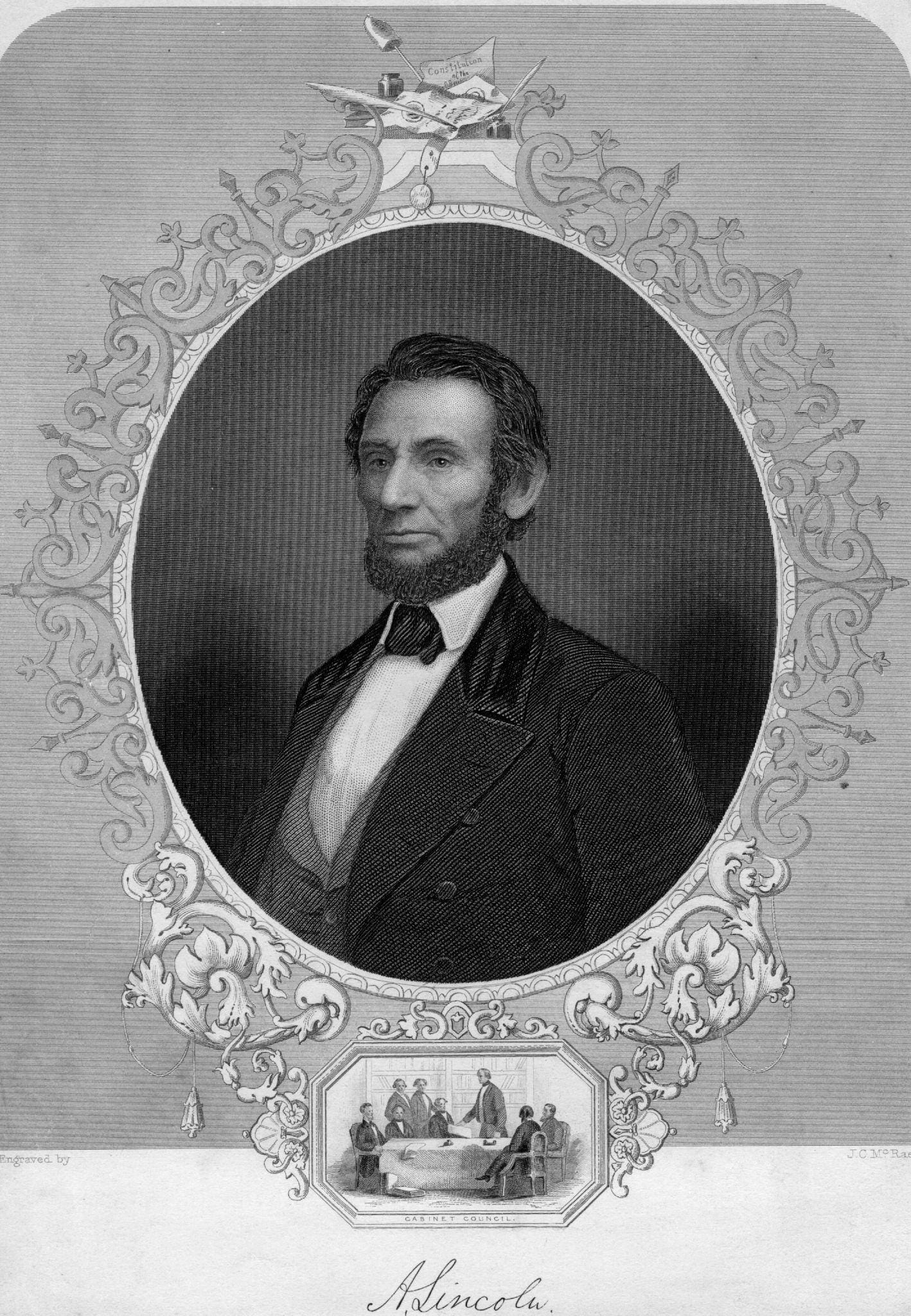
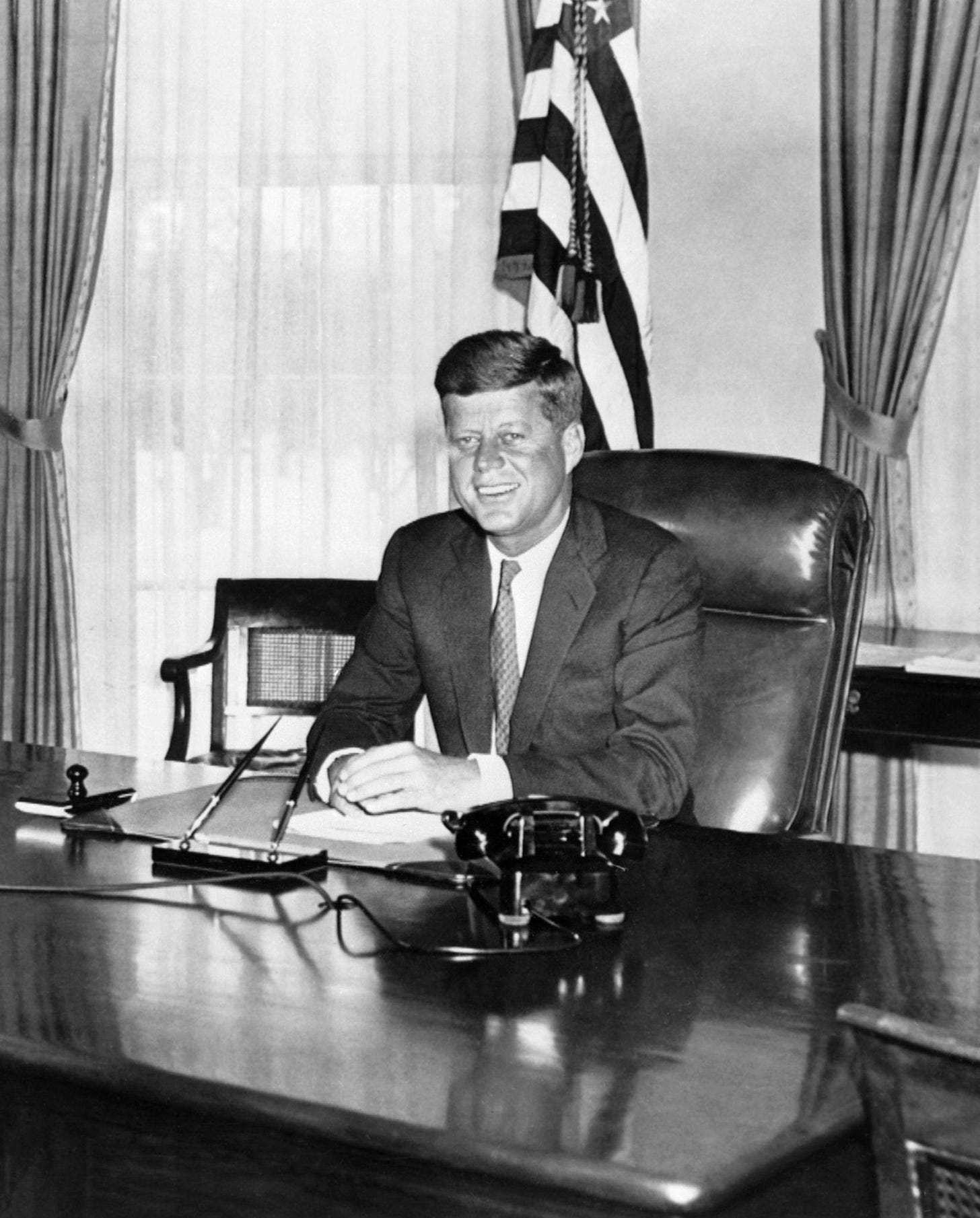
From George Washington to Abraham Lincoln, from John F. Kennedy to Ronald Reagan, our history is filled with leaders who governed amid fierce disagreement. Some were loved. Some were despised. All were contested.
But listen closely to how they spoke about political opposition.
Lincoln, in his First Inaugural Address, reminded a nation on the brink of civil war:
“We are not enemies, but friends. We must not be enemies. Though passion may have strained, it must not break our bonds of affection.”
He did not say his opponents were correct. He did not pretend there were no grave moral differences. He simply refused to declare half the country irredeemable.
That distinction matters.
John F. Kennedy echoed this sentiment in 1961:
“Let us never negotiate out of fear. But let us never fear to negotiate.”
Strength without paranoia. Conviction without demonization.
And Ronald Reagan, in his first inaugural, offered this:
“We are a nation that has a government—not the other way around.”
The reminder was subtle but powerful: power flows from the people, and the people must see one another as citizens first—not as combatants.
When Politics Becomes Identity
Today, too often, politics has ceased being about persuasion and become about belonging.
We no longer ask, “Is this policy wise?”
We ask, “Is this my tribe?”
And when politics becomes tribal identity, disagreement feels like betrayal. Critique feels like war. Compromise feels like capitulation.
This is how “US vs THEM” tribalism corrodes civic trust.
It teaches us to dismiss arguments without examination simply because of who makes them. It conditions us to interpret motives in the worst possible light. It convinces us that those across the aisle are not merely mistaken, but malicious.
And that is where republics begin to unravel.
Because a republic depends on something fragile: good faith.
Good faith does not mean naïveté. It does not mean blind trust. It does not mean abandoning accountability.
It means assuming that most of our fellow citizens—left, right, and in between—are not cartoon villains. They are human beings operating from their own lived experiences, fears, hopes, and convictions.
Unity Is Not Uniformity
Let me be clear: unity does not mean unanimity.
We will not agree on everything. We are not supposed to.
The Framers expected disagreement. They built systems to channel it productively. Checks. Balances. Debate. Elections. Courts. Amendments.
What they did not anticipate was a culture in which large swaths of citizens would dismiss entire categories of people as fundamentally illegitimate.
Unity is not about erasing differences.
It is about maintaining a shared commitment to the rules of the game.
It is about recognizing that when the balance of power inevitably shifts—and it always does—the same standards we demand for our opponents will be applied to us.
If we cheer overreach when it benefits our side, we forfeit the moral ground to object when it harms us.
That is not statesmanship. That is short-term tribalism.
Calmer Heads and Courageous Citizenship
Presidents Day should remind us that leadership is not measured by how loudly one excoriates opponents, but by how steadfastly one protects the republic—even when doing so disappoints one’s own supporters.
Washington warned against “the baneful effects of the spirit of party.”
He understood that faction, untethered from virtue, would corrode the common good.
And that is where we are tested today.
Not in whether we can win arguments online.
Not in whether we can craft the sharpest meme.
But in whether we can lower the temperature when outrage is profitable.
It takes courage to refuse to HATE.
It takes courage to criticize your own side when necessary.
It takes courage to listen to someone wearing a different “jersey” and say, “Help me understand.”
This is not weakness. It is disciplined strength.
The kind of strength Lincoln embodied when he refused to treat political foes as permanent enemies.
The kind of strength Kennedy showed when he sought dialogue in the shadow of nuclear threat.
The kind of strength Reagan invoked when he reminded us that government is accountable to the people—not the other way around.
A Personal Plea This Presidents Day
We are living in different informational universes.
We are tempted daily by voices that profit from keeping us scared, suspicious, aggrieved, and perpetually offended.
But we are still one people.
A republic does not require us to agree.
It requires us to believe that the person across from us loves this country too—even if they express that love differently.
So this Presidents Day, let’s honor the office not by blind loyalty to any individual, but by recommitting ourselves to the principles that make peaceful self-governance possible.
Let’s choose unity without demanding uniformity.
Let’s choose courage without contempt.
Let’s choose to see political opponents as wrong when we believe they are wrong—but not as evil beyond redemption.
If we can do that, if we can recover even a modest shared sense of humility and good faith, then the republic has a fighting chance.
And maybe one day, when future generations look back on this era, they will not remember us as the people who surrendered to tribal rage.
They will remember us as the citizens who steadied the ship when it mattered most.
Not perfectly.
But courageously.
Originally published on Substack. Shared here for broader access.
Comments & Upvotes